
The idea in one sentence
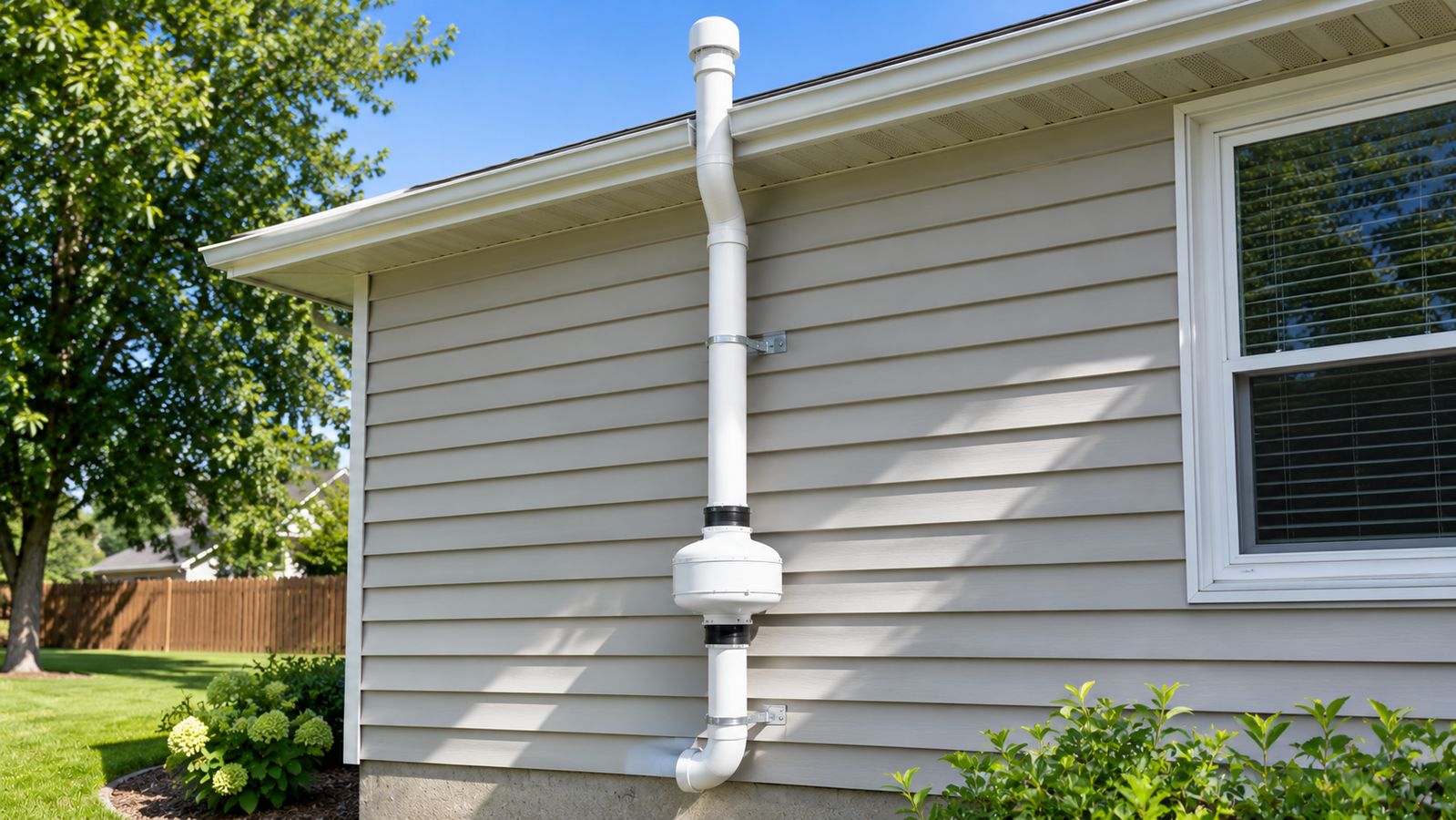
A fan creates gentle suction under your floor so that soil gas flows into a pipe and out above the roof, not into your basement.
The parts
- Suction point: a hole through the slab with a small pit cleared beneath it, so air can be drawn from a wide area.
- Pipe: PVC, sealed at the floor, running up the outside wall or through the house.
- Fan: mounted outside the living space, running all day and night.
- Discharge: the pipe ends above the roofline and away from windows.
- Sealing: cracks, sump lids and gaps are closed so the fan is not pulling house air.
- Gauge: a U-shaped tube of coloured liquid on the pipe. Uneven levels mean the fan is working.
Different foundations
Basements and slabs use the system above. Crawl spaces get a sealed plastic membrane over the soil with suction beneath it. Some homes with drain tile or a sump can use those as the collection point.
How well it works
The U.S. EPA says these systems can reduce radon by up to 99 percent in some homes. Results depend on the house, which is why a follow-up test after installation matters. Your provider should tell you what level they expect to reach.
Living with a system
- Leave the fan on. Check the gauge now and then.
- Retest every couple of years, and after remodelling or foundation work.
- If the gauge reads level or the fan goes quiet, call the installer.
Ready for a quote? See radon mitigation in Grand Island or the cost guide. Grand Island Radon is a referral service, not a radon contractor. We do not perform testing or mitigation. Enquiries are passed to an independent local provider licensed by the State of Nebraska, who sets their own prices and terms.